I have spent a considerable part of my career with code reviews: setting up review processes, writing guidelines, reviewing other people’s code, having mine reviewed, and arguing about both. I still consider them one of the most important guard-rails a software organisation has. They protect quality inwards, for the team that has to live with the code, and outwards, for the customer, the auditor and the operator who never sees it.
And yet, honestly, the classic code review was always fragile. Guidelines covered the baseline — naming, formatting, the obvious anti-patterns — but never the tricky parts that actually hurt in production. Reviews were time-consuming and got postponed. And their quality depended almost entirely on the skill set and the mindset of whoever happened to be the reviewer that day.
AI changes the economics of this completely. I can configure a review agent with every rule my project must follow, let it explore the repository instead of only the diff, and get a detailed review within minutes of pushing a change. So, all good?
No. In my experience the AI era turns two problems that were always there into problems we can no longer ignore: trust and cost versus benefit. This article argues two theses:
- An AI reviewer that does not learn cannot be trusted — and trust only develops when feedback and learning are visible and measurable.
- A review process that is not measured is now a cost centre on assumption — the era in which code review was an unquestioned ritual is over.
I will use screenshots from AI-Git-Bot, the open-source review bot I maintain, as an illustration of what tool support for both theses can look like. The argument does not depend on that tool; the figures in the screenshots come from a demo installation and are not research results.
What the research always said about human reviews
It is worth recalling what code review actually delivered before AI, because it was never what most process documents claimed.
Bacchelli and Bird observed, interviewed and surveyed developers at Microsoft and found that while finding defects remains the main motivation for review, reviews are less about defects than expected and instead provide benefits such as knowledge transfer, increased team awareness and alternative solutions.[1]
The research also confirms what every team lead knows from experience: review quality is a property of the reviewer. At Microsoft, Bosu et al. showed that reviewers who had worked on a file before give more useful comments, and that new hires had the lowest density of useful comments during their first months.[2]
Finally, human attention is the hard limit. Every experienced reviewer knows the point in a large diff where reading turns into scrolling.
This is the background against which the AI reviewer arrives: a process that depends on scarce, unevenly distributed expertise, limited attention and goodwill. An AI reviewer has unlimited attention, never gets tired at line 400, and applies every rule every time. That is a genuine leap. It is also exactly where the problems begin.
Thesis 1: Trust is not a property of the review, but of the reviewer
When a colleague comments on my pull request, I never read the comment alone. I read it in context: What is this person’s expertise? How long have they been working on this project — do they know the special cases, the historical decisions, the customer who insists on that odd behaviour? Are their reviews usually thorough or usually superficial? What are their preferences, and which comments are therefore taste rather than defect?
That context is how I decide, within seconds, which comments to act on, which to discuss and which to politely ignore. Code review has always been an inter-human process, and its content has always been weighed by the reputation of its author.
The AI reviewer has no reputation. Worse: by default it has no memory. Every review starts from zero. A finding I refuted last week, with a perfectly good reason, comes back next week with the same confidence. A reviewer who never remembers your answer is not a colleague — it is a junior in their first week, forever.
More findings, more to verify
The second part of the trust problem is volume. My own experience with AI-generated reviews is consistent: the agent finds more and writes more than a human reviewer, and every finding has to be verified. Verification is not free. It costs time — and if I want my answer to be respected next time, writing that answer costs time as well.
The first industrial studies point in the same direction. Cihan et al. studied an LLM-based review tool in an industrial setting with 4,335 pull requests: 73.8% of the automated comments were resolved, but the average pull-request closure time increased from five hours 52 minutes to eight hours 20 minutes, and the authors list faulty reviews, unnecessary corrections and irrelevant comments as drawbacks.[3] Developers notice: in the 2025 Stack Overflow survey, more developers actively distrust the accuracy of AI tools (46%) than trust it (33%), and the biggest frustration, cited by 66%, is “AI solutions that are almost right, but not quite”.[4]
“Almost right” is the most expensive kind of review comment. A wrong comment is dismissed in seconds. An almost-right comment forces you to reconstruct the reasoning, check the code, and decide. A reviewer tuned to maximise its findings therefore does not save time — it moves the time from writing the review to reading it. The real design goal is to balance findings against the cost of being wrong.
The opposite danger: trusting it too much
There is a second failure mode, and in the long run I consider it the more dangerous one. Once an AI reviewer is right most of the time, people stop checking. Automation bias — the propensity to favour suggestions from automated systems and to ignore contradictory information, even when it is correct — is well documented far beyond software. Parasuraman and Manzey’s review concludes that automation bias occurs in naive and expert participants alike, cannot be prevented by training or instructions, and affects individuals as well as teams.[5] In code review, this shows up as approving the bot’s silence: “The bot found nothing” quietly becomes “there is nothing”.
The goal is therefore not maximum trust, but calibrated trust — trust that matches the actual capability of the reviewer. Both under-trust (ignoring a correct blocker in a flood of noise) and over-trust (merging because the bot was quiet) are failures of calibration.
So: only a learning reviewer can earn trust
How do humans calibrate trust in a new colleague? We discuss findings that are unclear, we reach consensus, and we expect the colleague to remember it. After a few months we know where they are strong and where to double-check. My claim is that an AI reviewer needs exactly the same loop — not as a metaphor, but as tool support:
Concretely, that means four capabilities. None of them is a model feature; all of them are process and tooling:
- Addressable findings. Every finding needs a stable reference, so that a human can say “this one is wrong, and here is why” — not in a chat window, but where the review happens, in the pull request.
- Structured verdicts. Useful, incorrect, irrelevant, needs improvement — with a reason. Without a structured verdict there is no precision figure, and without a precision figure “the bot is noisy” remains an anecdote.
- Curated lessons. Corrections that recur must become guidance that later reviews receive — scoped to the repository and the paths it concerns, versioned, with the feedback that justifies it and a person who activated it.
- Expiry. Code moves; guidance does not move with it. A lesson needs a recheck date and must drop out when its evidence is withdrawn.
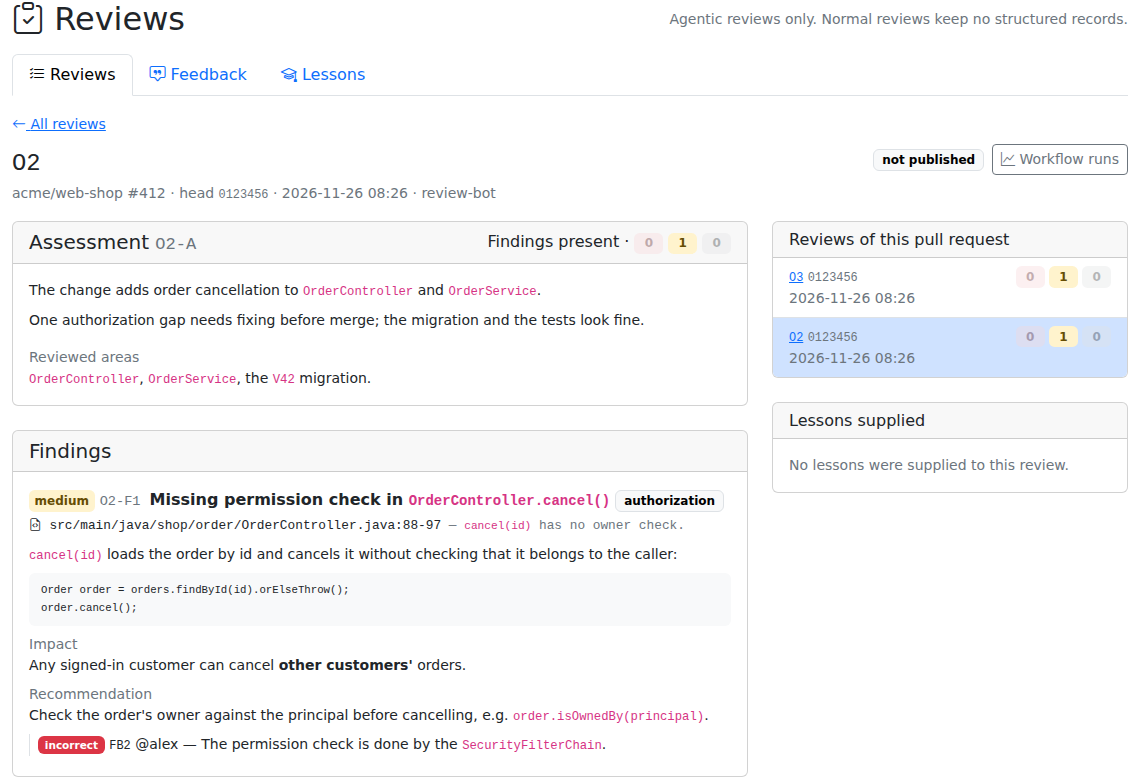
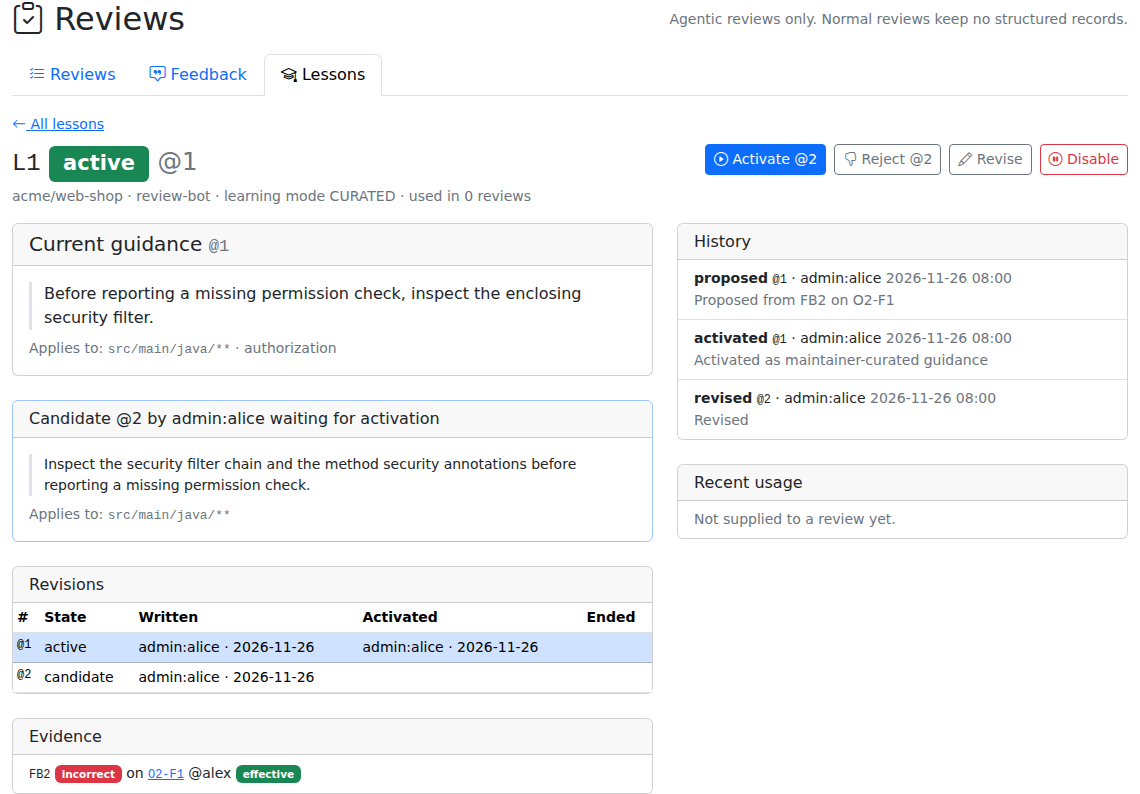
This is not hypothetical at scale. ByteDance’s BitsAI-CR describes a “data flywheel” in which structured feedback and an Outdated Rate — whether flagged code is actually changed afterwards — drive continuous improvement; they report 75.0% precision and more than 12,000 weekly active users.[6]
Here is the point where I deliberately disagree with a popular direction: lessons must be curated by humans, not learned automatically. A reviewer that silently rewrites its own guidance from every annoyed comment is not learning; it is drifting. Guidance that changes what the reviewer tells the whole team is repository policy, and policy needs an owner. The permission to give feedback must never be the permission to change policy. Fine-tuning the model is not the answer either: what a team needs is not a smarter model, but a model that is told, in a traceable way, what this particular team has already decided.
Thesis 2: Code review was never measured. That era is over.
In all the projects I have worked in, tracking the return on investment of code review was the exception. Review was considered an internal part of software development that needed no measurement. It was justified — rightly — by softer benefits: avoiding knowledge silos, spreading understanding of the codebase, building acceptance of the code within the team. The research cited above supports exactly these benefits.[1]
Let me be slightly provocative: we did not measure code review because we did not want to know the answer. A process that consumes a significant share of senior engineers’ time, finds defects in only a fraction of its comments, and depends on who happens to be available would have been hard to defend on numbers alone. So we defended it on principles.
AI shifts the cost structure and thereby forces the question. Producing a review is now cheap — in my experience a few cents to a few euros per pull request. Verifying and applying it is not. The cost has moved from writing the review to reading it. And with AI-assisted coding, the amount of code that reaches review is growing faster than the number of people who can read it.
Perception is no substitute for measurement here. In METR’s randomised controlled trial, experienced open-source developers using AI tools took 19% longer to complete their tasks — while still believing afterwards that AI had sped them up by 20%.[7] If developers misjudge the effect of AI on their own work by almost 40 percentage points, I see no reason to assume that teams judge the effect of AI on their reviews more accurately.
What I want to measure
The review process itself should become a measured process, with a handful of figures that answer concrete questions:
| Metric | Question | What it does not prove |
|---|---|---|
| Findings per PR in the first review | Is the code getting better before review? | That fewer findings means better code — the reviewer may have gone quiet |
| Review rounds until no blocker | Do fixes converge, or create new findings? | Anything about a single PR |
| Resolved / persisting / new findings | Are findings actually addressed? | That a resolved finding was correct |
| Precision and feedback coverage | Do the humans agree with the reviewer? | Anything when coverage is low |
| Hot spots by directory and category | Where does the code keep failing review? | Whose fault it is |
| AI cost per accepted blocker | What does a real, serious finding cost? | The value of the blocker itself |
| Estimated return | Is it plausibly worth it, under stated assumptions? | Anything without the assumptions next to it |
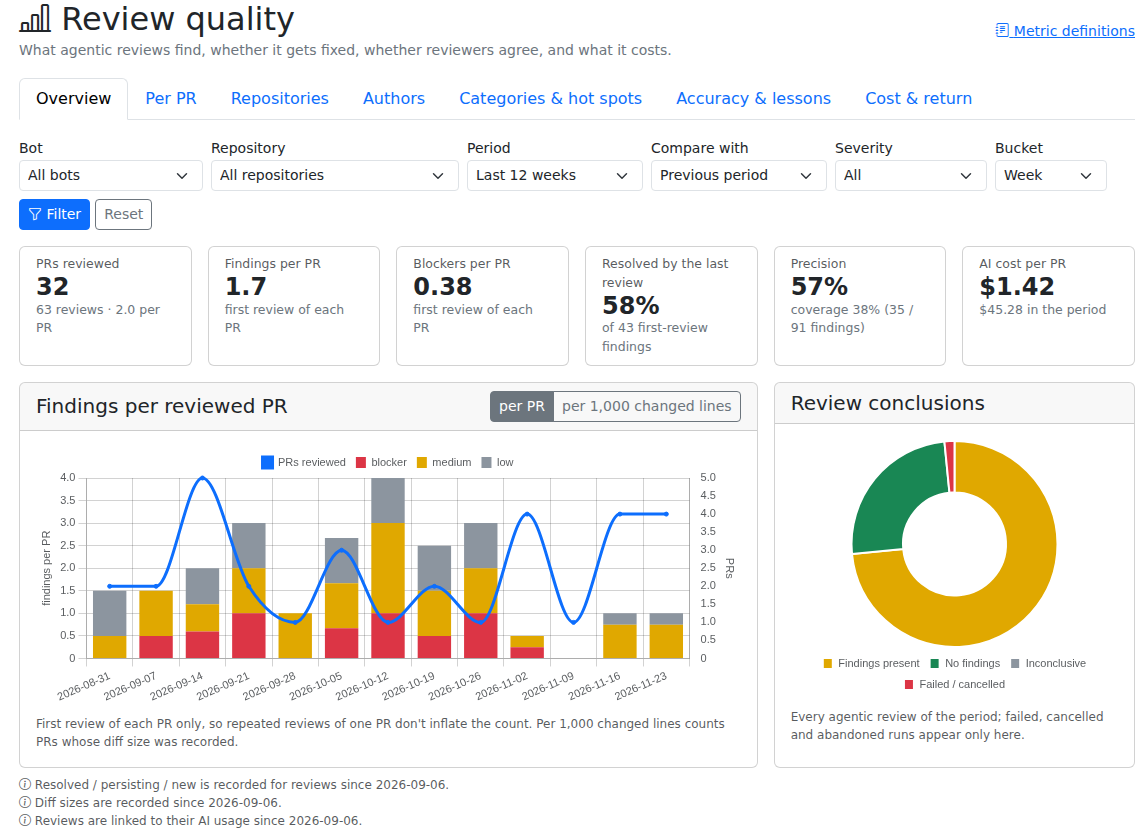
The trend of findings per pull request and of review rounds is, in my view, also one of the most honest team-performance metrics we have. Does the team deliver code with fewer findings over time? Do fixes converge in fewer rounds? Unlike lines of code or story points, these figures measure the quality of what reaches the reviewer — and they are recorded as a by-product of work that happens anyway.
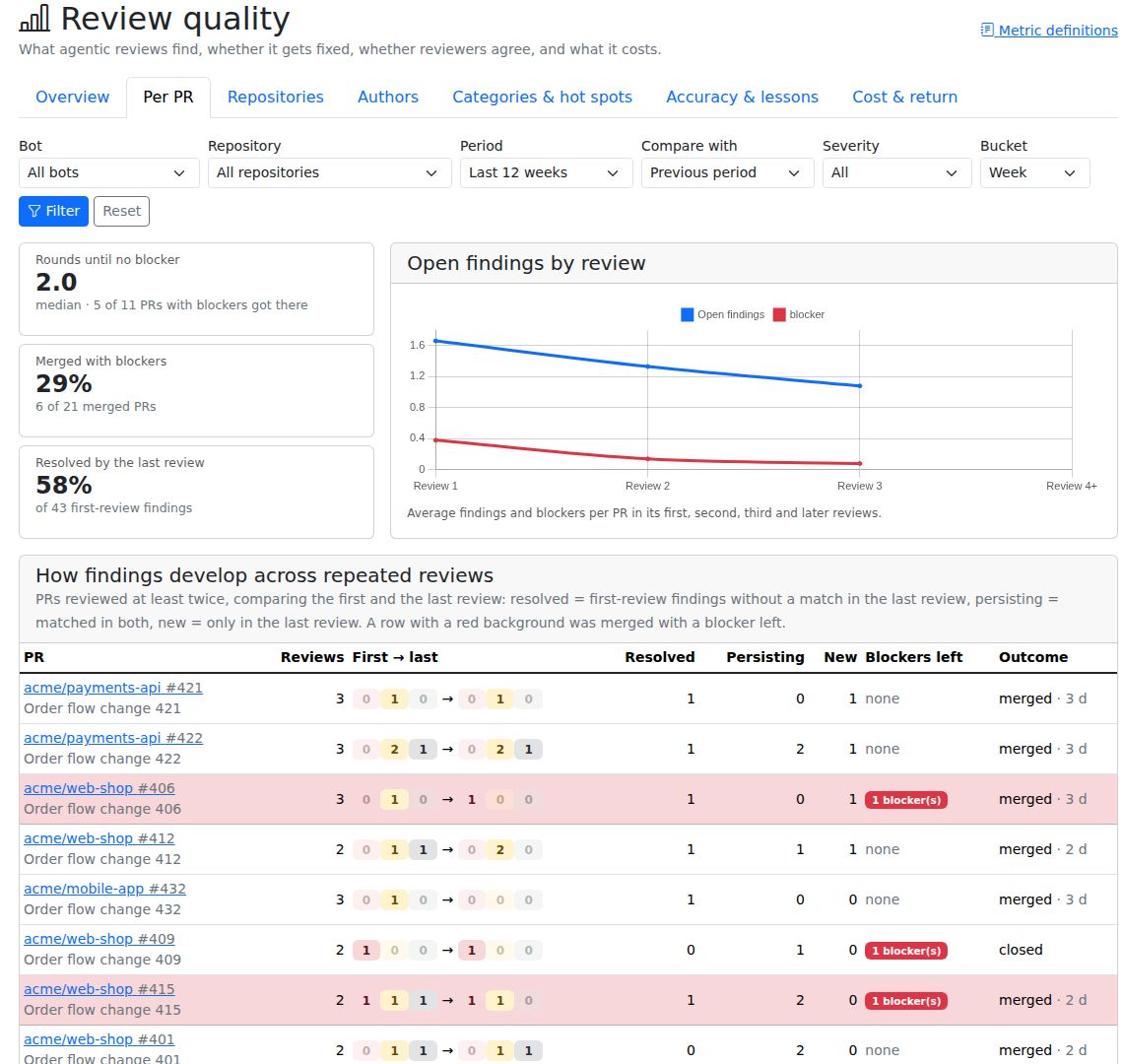
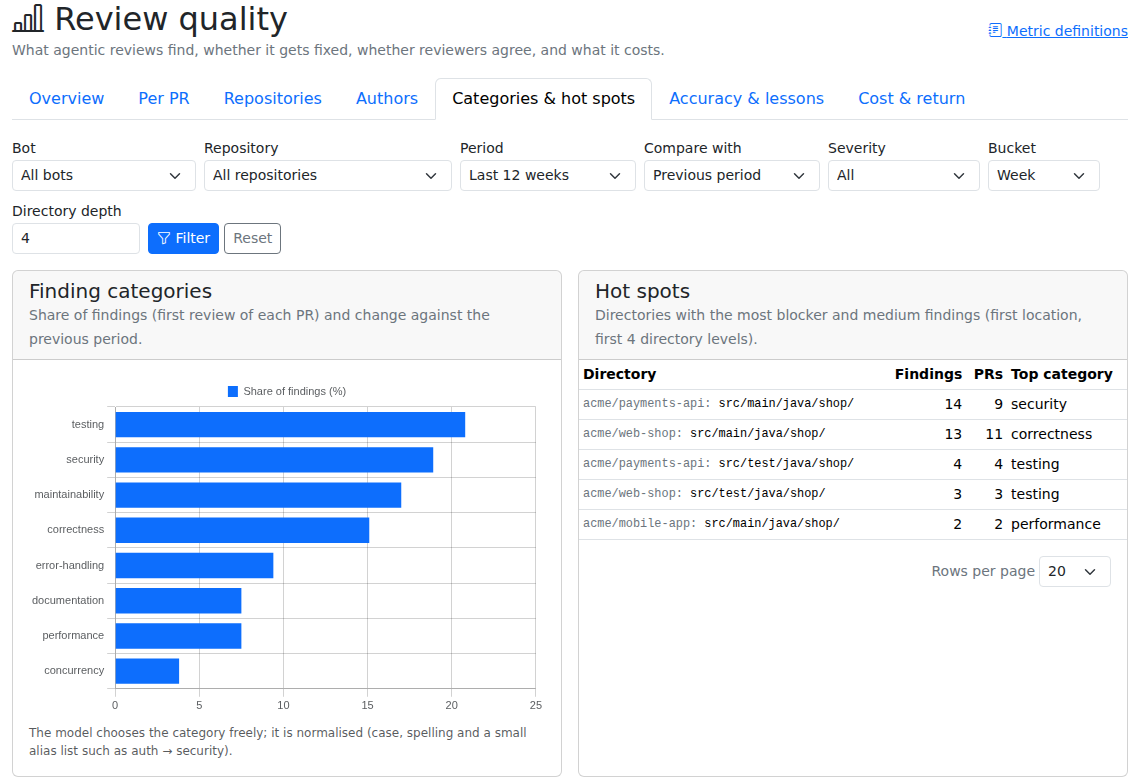
Hot spots turn review data into engineering decisions. A directory that keeps producing security findings is not a review problem; it needs a shared helper, a framework-level check or a refactoring. A module with many testing findings is usually hard to test — that is a design conversation, not a review comment.
Cost and return — with the assumptions on the table
The breakdown of AI cost against saved cost is, I believe, essential — precisely because it was never done for human reviews. The AI cost is measured; it is the token usage of the review runs, priced when they ran. The return is an estimate: minutes saved per accepted finding by severity, minus minutes lost per incorrect finding, times an hourly rate.
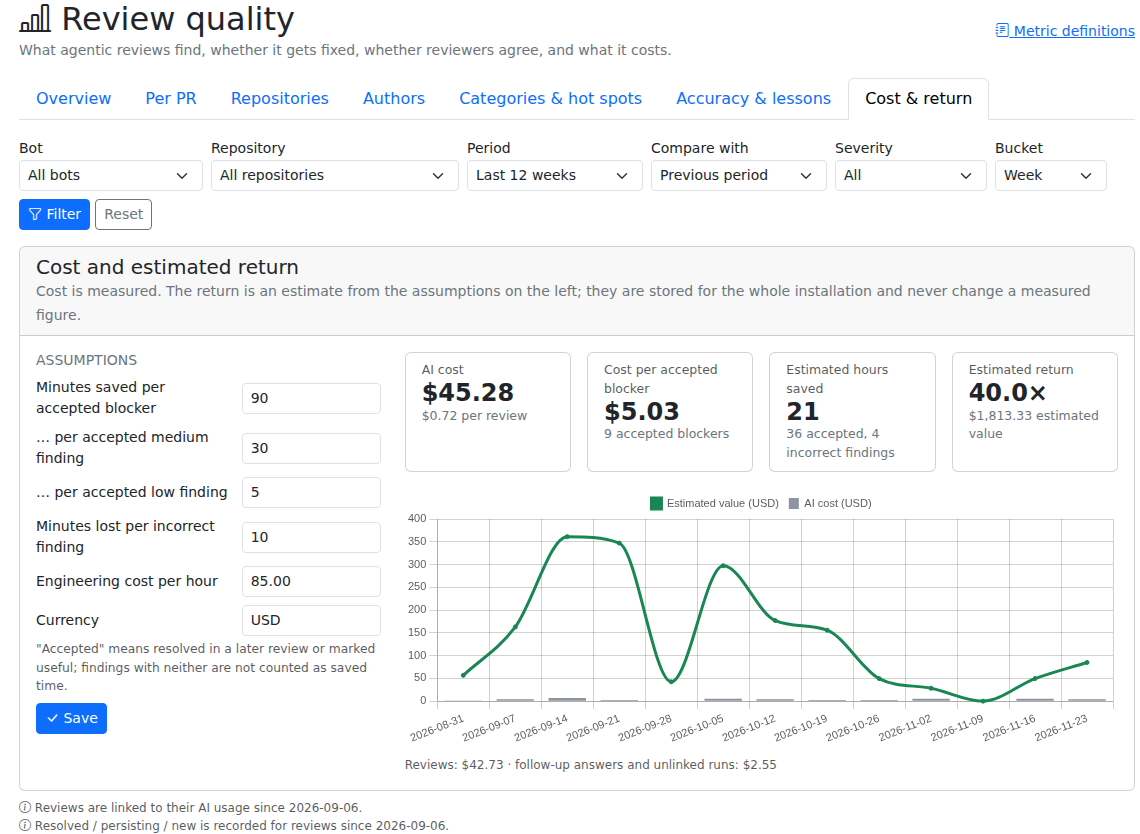
I want to be clear about the epistemics. The estimated return is only as good as its assumptions, and the assumptions must be visible next to the figure and agreed with the team before anyone shows it to a budget holder. The figure that does not depend on assumptions is cost per accepted blocker: both sides are measured, and it compares directly with the cost of a production incident. An honest model also charges the reviewer for being wrong: minutes lost per incorrect finding are real discussion time, and leaving them out turns an estimate into marketing.
Measuring closes the trust loop
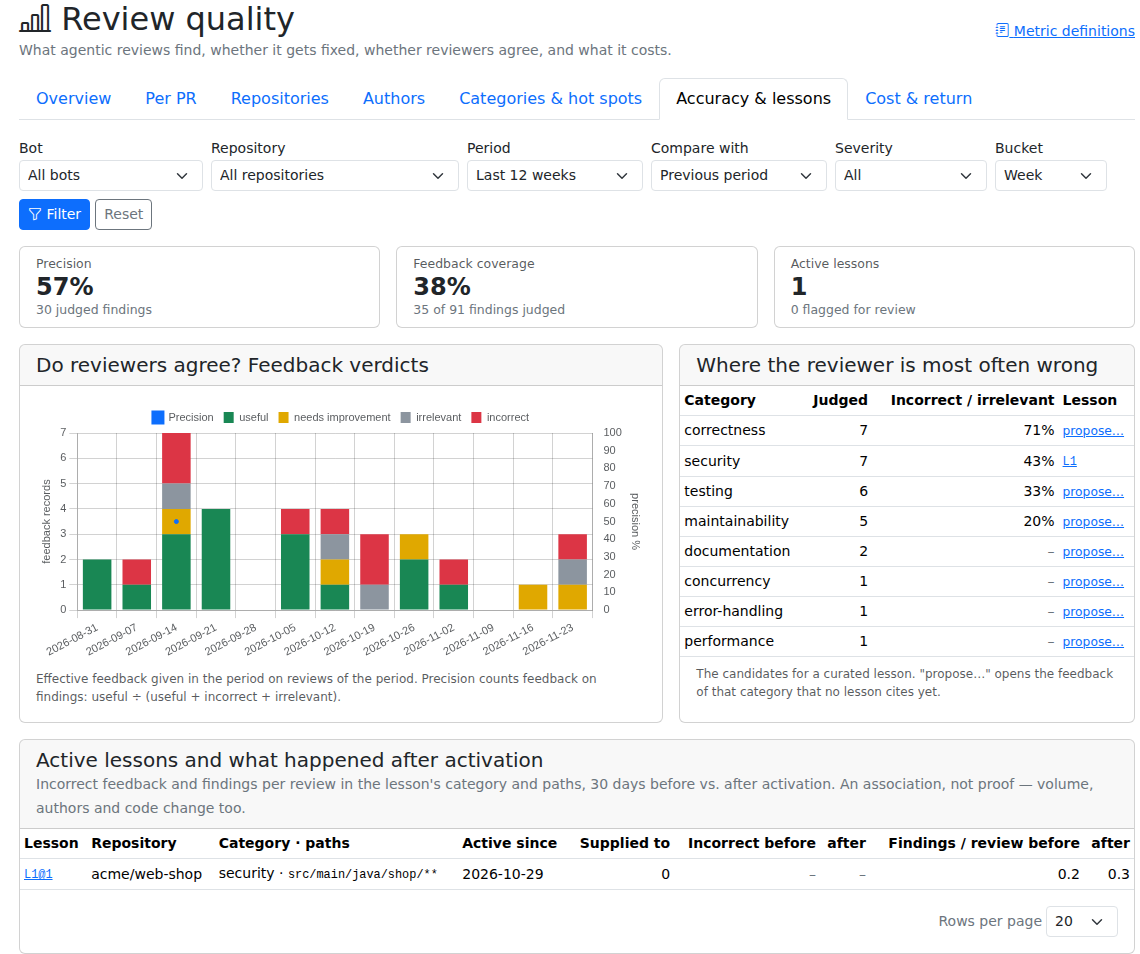
The two theses meet here. Precision over time, broken down by category, is the measurable form of trust. It shows where the reviewer is reliable and where its findings need a second look — which is exactly the calibration described above. And it shows whether a lesson helped: if the incorrect rate in a category drops after a lesson was activated, the learning loop works; if findings in that category drop to zero, the lesson may have switched the reviewer off.
Objections I take seriously
“Metrics will be gamed.” Yes, if they are used to rate individuals. Findings per author must be a coaching instrument — sorted by name, never ranked, with small samples grouped — or people will start writing pull requests for the bot instead of for the product, and honest feedback will stop. Team-level trends are a different matter; hiding them helps nobody.
“The softer benefits will be lost.” This is the objection I agree with most. Knowledge transfer and acceptance of the codebase were always the real return of human review,[1] and an AI reviewer delivers neither. My conclusion is not to keep humans on the line-by-line work, but to reinvest the time AI saves there into what only humans can do: discussing design and intent, onboarding, shared ownership of the risky parts. If AI review only lets you review less, you have optimised the wrong thing.
“Correlation is not causation.” Correct. A lesson followed by a lower error rate is an association; volume, authors and code change at the same time. But the alternative is not causal proof — it is no data at all, which is what we had before.
“The evidence on AI reviews is still thin.” True — the first industrial studies are only now appearing, and every one of them describes a single organisation. The direction is nevertheless consistent across industrial studies and developer surveys: more output, more review load, fragile trust.
Conclusion
AI has removed the bottleneck that defined code review for decades — scarce, tired, unevenly skilled human attention. It has not removed the two questions every review process should always have had to answer: Can I trust this reviewer? and Is this worth its cost?
My answer to the first is that trust in an AI reviewer has to be earned the same way it is earned between people: through discussion, consensus and memory — implemented as structured feedback and curated, expiring lessons. A reviewer that cannot learn from its corrections will either be ignored or, worse, blindly followed.
My answer to the second is that the review process itself must become measurable: findings per pull request, rounds until convergence, precision, hot spots, and AI cost against an honestly estimated return. These figures are not bureaucracy. They are what lets a team trust an AI that reviews its codebase, and what lets an organisation improve its software engineering rather than just accelerate it.
Code review used to be a ritual we believed in. In the era of AI, it has to become a process we can prove.
Sources
- Bacchelli, Bird: Expectations, Outcomes, and Challenges of Modern Code Review (ICSE 2013)
- Bosu, Greiler, Bird: Characteristics of Useful Code Reviews: An Empirical Study at Microsoft (MSR 2015)
- Cihan et al.: Automated Code Review In Practice (ICSE SEIP 2025)
- Stack Overflow 2025 Developer Survey: AI
- Parasuraman, Manzey: Complacency and Bias in Human Use of Automation (Human Factors 2010)
- Sun et al.: BitsAI-CR: Automated Code Review via LLM in Practice (2025)
- METR: Measuring the Impact of Early-2025 AI on Experienced Open-Source Developer Productivity (2025)