Imagine your CISO asking: “This AI bot that reviews our code — who can administer it, what exactly did it do last Tuesday, and can we prove the record wasn’t touched?”
With AI-Git-Bot 1.18, you have an answer. Shipping today. 🚀
First time here? 30-second intro 👋
AI-Git-Bot is the open-source AI teammate that lives inside your Git tool — Gitea, GitHub, GitHub Enterprise, GitLab, Bitbucket Cloud. It reviews PRs, writes tests, turns issues into pull requests, keeps docs and translations in sync, and runs E2E suites against preview deployments. Self-hosted, provider-independent (OpenAI, Claude, Gemini, or local Ollama models), and MIT-licensed.
You assign it work the same way you’d assign it to a colleague: request it as a PR reviewer, assign it an issue, or @mention it in a comment.
👉 Want the long-form pitch? Read
doc/pitch/PITCH.md— it’s the fastest way to decide whether AI-Git-Bot is for your team.
What’s new in 1.18 — the highlights
This release is different. Not one feature makes the AI smarter. Instead, 1.18 answers the questions organizations ask before they let software anywhere near their source code. Let’s walk through them.
🔐 1. OAuth2/OIDC login — meet your identity provider
The admin UI used to have its own little user database with username/password login. Fine for a homelab — a non-starter where credentials must come from a central IdP.
Now the login method is a configuration switch:
GITEABOT_SECURITY_LOGIN_METHOD=native— the existing database login, unchanged. Current installations keep working exactly as before.GITEABOT_SECURITY_LOGIN_METHOD=oauth— the entire UI authenticates via OAuth 2.0 Authorization Code flow against your provider.
OIDC issuer discovery is built in, so Microsoft Entra ID and Keycloak work by pointing at a single issuer URL — no manual endpoint wiring.
Why your org will love it: the bot joins your existing SSO landscape. Admin onboarding and offboarding happen in your IdP, access follows your central policies, and there is no shadow user database left to audit.
📜 2. Tamper-evident audit trail — “what exactly happened?”
This is the headline. AI in the development workflow raises a legitimate question from security and compliance teams: what did the bot actually do — and can we prove it later?
1.18 introduces a structured, append-only audit trail for every PR workflow execution:
- Full lifecycle coverage — run started, every step, run completed/failed/cancelled, every review decision
- Agent tool-call tracing — every tool the LLM invokes, with sanitized arguments, result summary and duration. You can reconstruct the agent’s decision path step by step
- Cost correlation — events carry token usage and link to AI usage sessions, connecting what happened to what it cost
- Tamper evidence — every event is chained to its predecessor with a per-run SHA-256 hash chain. Insert, alter or delete a record and the chain breaks. The history isn’t just stored; it’s provably intact
- Configurable retention — a nightly garbage collector prunes events older than your window (default 90 days, e.g.
AUDIT_RETENTION=P180D) to match your data-retention policies
And it never gets in the way: auditing is fire-and-forget, it cannot block or fail the workflow it observes.
Why your org will love it: this turns “we use an AI bot” into “we can govern an AI bot.” Internal audits, ISO 27001 / SOC 2 style assessments, post-incident reviews — they all start with show us the record. Now there is one, and it’s tamper-evident by construction.
📡 3. Outgoing webhooks — the bot talks to your systems
Until now, AI-Git-Bot only received webhooks from Git platforms. It now also emits them. Admins configure endpoints under System settings → Outgoing webhooks and subscribe each one to the events that matter — workflow started/completed/failed, agent-review findings with their severity, issue-assignment lifecycles for the CodingBot and WriterBot.
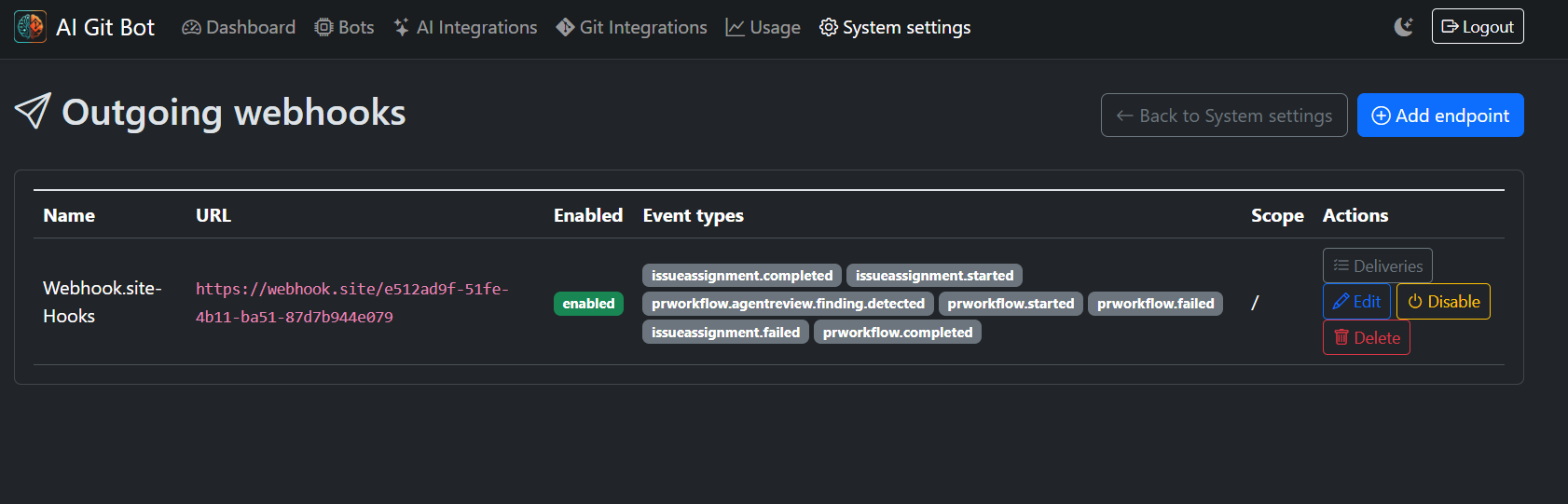
Built for enterprise plumbing:
- Durable, at-least-once delivery — persisted before dispatch, retries with exponential backoff, survives restarts
- HMAC-SHA256 signing per endpoint (GitHub-style), plus optional Authorization and custom headers
- Scoped subscriptions — global, per-bot, or per-repository
- Encrypted secrets at rest with the same AES-GCM encryption that protects AI provider keys
- Delivery log with manual retry in the admin UI
Why your org will love it: forward findings to your SIEM, open a ticket on blocker-severity findings, post to Slack/Teams when a workflow fails, feed a custom compliance archive — in real time, without polling. This is the integration point your platform team has been asking for.
📊 4. Prometheus metrics — operational visibility
Observability is table stakes for production. The bot now exposes a standard scrape endpoint at /actuator/prometheus: review and finding counts, workflow run counts and durations, LLM statistics (tool rounds, tool calls, token usage), errors and failures — all with deliberately low-cardinality labels so they behave in real Prometheus deployments.
Why your org will love it: the bot shows up in your existing Grafana dashboards and alert rules next to everything else you operate. Token-spend anomalies and workflow failure spikes become visible before users report them.
⚖️ 5. Deterministic review gates — the LLM advises, the system decides
When the agentic PR review was allowed to submit formal decisions (approve / request changes), the LLM made the final call itself. For a merge gate, a probabilistic decider isn’t good enough.
The decision logic has been inverted:
- The LLM only classifies findings by severity —
BLOCKER,MEDIUM,LOW— and reports counts - The application computes the review action deterministically against thresholds you configure (e.g. approve only if
BLOCKER ≤ 0) - No thresholds configured? The bot posts its review and leaves the review state untouched
Same model, same findings — but the approve/reject decision is now a reproducible function of explicit policy, not of model mood.
Why your org will love it: you can put an AI review in the merge-blocking path and explain the decision rule to an auditor in one sentence. Policy lives in configuration, not in a prompt.
🐳 6. One-command evaluation — curious to running in seconds
Finally, we removed the last evaluation friction. No checkout, no Docker Compose needed for a first look:
docker run -p 8080:8080 tmseidel/ai-git-bot:latest
The container starts with sensible defaults and an embedded H2 database. Docker Compose with PostgreSQL remains the production path — but the first five minutes with the product should never be harder than one command.
The bigger picture: maturity is a feature
Look at the shape of this release:
- Who can administer it? — your IdP says so (OAuth2/OIDC)
- What did it do? — a tamper-evident audit trail says so
- How do our systems learn about it? — outgoing webhooks say so
- How do we operate it? — Prometheus metrics say so
- Can we trust its gates? — deterministic thresholds say so
Building auditing is a deliberate statement. AI-Git-Bot is not an experiment that happens to run in a company — it is a platform designed to be integrated into one. Self-hosted and provider-independent from day one, and now auditable, observable and SSO-enabled, it fits environments where compliance and security aren’t afterthoughts but entry requirements.
And since evaluation is a single docker run away, the distance between “interesting project” and “running under our own policies” has never been shorter.
Get it now
docker run -p 8080:8080 tmseidel/ai-git-bot:latest
- ⭐ Star us on GitHub: https://github.com/tmseidel/ai-git-bot
- 📖 Docs: User Guide · Audit Trail & PR Workflows · Outgoing Webhooks · Deployment
- 🐛 Found something? Open an issue — we read every one.
The bottom line: in 1.18, AI-Git-Bot stops being just the helpful AI teammate and becomes one your security, compliance and platform teams can sign off on. The chores still get done — every PR, forever — but now with SSO, an audit trail, real integrations and deterministic gates around them.
Happy shipping. 🚀